
Start a Court Sports Facility
A planning guide for people still deciding, before a lease is signed. It starts with the floor plan: the courts, the run-off, the columns and the height. The money comes after, as sourced ranges you can check.
Who This Guide Is For
This series is for people deciding whether to open an indoor pickleball club, a badminton hall or a building that does both, and who haven't signed a lease yet. Maybe you've found a warehouse or an empty department store, or you're still searching. Either way, the questions come in the same order: will the courts fit, is the ceiling high enough, what will it cost and what has to go right for the numbers to work.
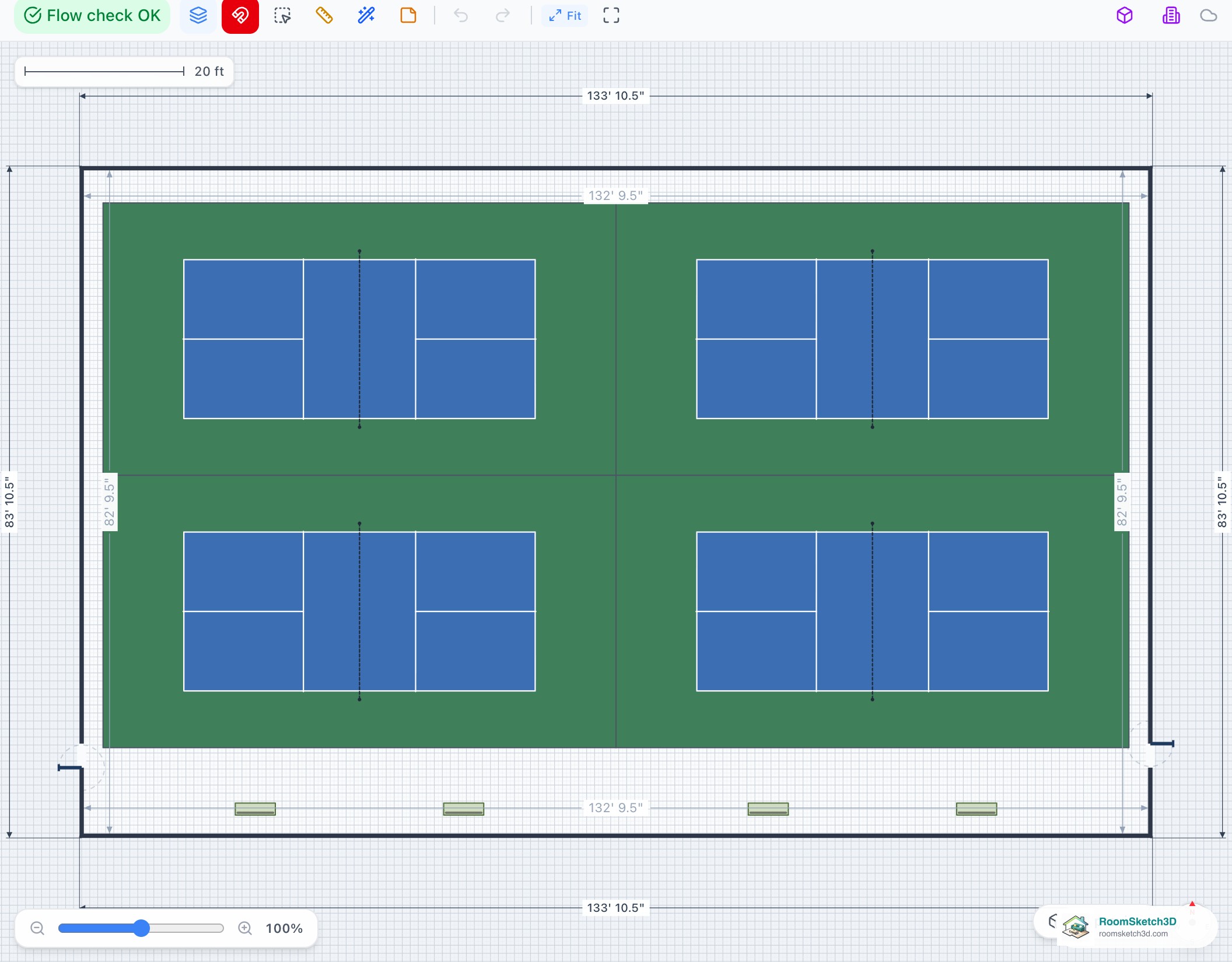
We make floor planning software, so we start where we know the ground best: space. A court is only part of the floor you need. Every court sits inside a larger playing surface with run-off around it, the building's columns decide where those surfaces can go, and the clear height under the lowest beam or light decides which sports you can offer at all. Get those three right on paper and the rest of the plan has something solid under it.
The money pages follow the same rule as the space pages: every number names its source and date, figures are given as ranges, and arithmetic we did ourselves is labelled as a worked example. Where a source couldn't be confirmed, we say so on the page.
The Five Decisions, in Order
Most people start with the money. We suggest starting with the building, because the building sets the number of courts, and the number of courts sets almost everything else: rent per court, build-out cost, staffing and how much revenue the place can earn at all.
- Building. Check the things you can't change first: clear height, the column grid, the floor slab, zoning, then exits and restrooms. See what ceiling height you need and what to look for in a building.
- Courts. Count playing surfaces, not courts, in rows and columns, then check that no column lands inside one. See how many courts fit in my building.
- Layout. Lobby, front desk, restrooms, divider nets and lights. See the layout guides for a 4-court pickleball club, an 8-court badminton hall, a mixed hall and outdoor courts.
- Cost. The line items and the published ranges, including what franchise disclosure documents show. See upfront cost, lease vs buy vs build and franchise or independent.
- Break-even. How revenue is built from occupancy, players per court and price, and the utilization your fixed costs require. See how these businesses make money and the break-even method.
The order matters because each decision limits the next. A building with 18 ft of clear height can take pickleball but not club-level badminton. A column grid that costs you one court out of six changes the rent per court by a fifth. It's cheaper to find that out with a floor plan than after the lease.
Pickleball vs Badminton: What Changes
The two sports share a court size, which makes them natural partners in one building. A pickleball court is 20 × 44 ft (6.10 × 13.41 m) under the 2026 USA Pickleball rulebook; a badminton doubles court is 6.1 × 13.4 m. What changes is everything around the lines.
Pickleball vs badminton: the planning differences
| Pickleball | Badminton | |
|---|---|---|
| Court | 20 × 44 ft (6.10 × 13.41 m) | 6.1 × 13.4 m doubles (same size) |
| Playing surface per court | 30 × 60 ft minimum; 34 × 64 ft recommended for new construction | About 9.1 × 17.4 m (29.9 × 57.1 ft) at club level (derived from Sport England run-offs) |
| Between side-by-side courts | Not set by the rulebook; 8–14 ft in secondary sources | 1.5 m shared (Sport England, club level) |
| Clear height | No rule; about 18 ft (30 × 60) to 21 ft (34 × 64) reported from the construction manual | 6.7 m (22 ft) community, 7.5 m (24.6 ft) club, 9 m international |
| Net | 36 in at the sidelines, 34 in at centre | 1.55 m at the posts, 1.524 m at centre |
| Lighting | About 30 fc recreational, 50 fc club (vendors citing the manual; unconfirmed) | 500 lux maintained average for club play |
| US court rental (2025–2026, few venues) | About $24–$44 per hour, off-peak to peak | About $25–$48 per hour |
Sources: USA Pickleball 2026 Official Rulebook; BWF Laws of Badminton (2026 page); Sport England Badminton Design Guidance Note (Dec 2011); venue price pages read November 2026. Details and caveats are on each topic page.
The practical consequence: a typical light-industrial or flex building, with 18–24 ft of clear height, suits pickleball. Club-level badminton usually needs a taller mid-bay or distribution building (24 ft and up). If you want both, the height decides, and the mixed hall guide shows how the run-offs line up.
The Market, Honestly
Pickleball has grown fast, and that's why so many indoor clubs have opened. The Sports & Fitness Industry Association counted 24.3 million US players in 2025, up 22.8% on the year, of whom about 7.5 million played eight or more times (SFIA reports, March and June 2026). Growth then slowed to 1.3% in the first half of 2026 (SFIA mid-year report, August 2026).
The resale market is the other signal. Nine US pickleball facilities listed for sale cut their asking prices over ten weeks by a typical 39%; one Florida indoor club went from $1.5 million to $600,000 (The Dink / IAPPF, 11 September 2026, from BizBuySell asking prices, not sale prices). The article put it bluntly: "your facility is not worth what you spent building it."
Busy clubs can lose money too. PDI Consulting's Dave Conord lists "awkward layouts, and columns that limit usable court space" among the reasons "good operators with full buildings still lose money" (The Dink, 20 October 2026). That's a floor plan problem, and it's why this series starts with the floor plan.
None of this means a club can't work. It means the margin for error is thinner than the growth headlines suggest, and the plan has to hold up on numbers you can check.
Tools: Court Layout and Break-Even Calculators
Two free calculators go with this series:
- Court layout calculator: enter the building's width, length, clear height and column spacing, pick a sport and a playing-surface size, and see how many courts fit, with warnings when the height is below the reported guidance or a column lands in play.
- Facility break-even calculator: enter your courts, hours, prices and fixed costs to see the utilization your plan needs to cover its costs, and how sensitive that is to rent, price and occupancy. It doesn't predict profit.
When you have a building in mind, draw it: the outline, the columns at their real spacing, the doors. Then drop in courts from the sports catalog and move them around until the columns sit in the gaps. The pickleball courts, badminton hall and sports park templates are ready-made starting points, and sports court dimensions with run-off lists the sizes for every court in the app.
What We Won't Tell You
We won't tell you a court facility is profitable, or how long it takes to pay back. Nobody can know that without your rent, your prices, your town and your competition, and published "typical" figures mostly come from people selling something: booking software, construction, franchises.
That's why the money pages give ranges, not single numbers. A franchisor's 2025 disclosure document and a vendor blog can both be accurate and still differ by a factor of ten, because one includes the building, HVAC, restrooms and lobby and the other is surface, nets and lights. Each range on these pages says what it covers and where it came from, so you can decide which ones apply to you.
We also don't recommend businesses. Where a franchise is named, it's because its disclosure document is a public source of cost data. Venue names next to prices are there because their price pages are where the prices came from.
Not financial advice. This page explains a planning method and quotes published, dated ranges. It isn't financial, legal or investment advice, and nothing here predicts that a facility will make money or how long it would take. Talk to an accountant, a lawyer and your lender before you commit.
Sources for this page
- USA Pickleball, 2026 Official Rulebook, Section 3 (court and playing surface).
- BWF, Laws of Badminton (worldbadminton.com page revised 5 May 2026).
- Sport England with Badminton England, Badminton Design Guidance Note, December 2011, Revision 003.
- SFIA participation reports, March, June and August 2026 (via sfia.org and pickleball.com).
- The Dink / IAPPF, 'Pickleball Facilities Are Up for Sale & Getting Cheaper, Fast', 11 September 2026.
- The Dink, 'Why busy pickleball clubs can still lose money', 20 October 2026 (PDI Consulting).
- Link Logistics, 'What Is Clear Height?' (undated, accessed November 2026).
Pro Tip
Ready to apply this to your own space? Sketch it to scale in the floor planner and check every clearance before anything moves.
Frequently Asked Questions
Common questions about start a court sports facility
Is opening an indoor pickleball place a good business?
Nobody can answer that for your town without your numbers. US participation reached 24.3 million players in 2025 (SFIA), but growth slowed to 1.3% in the first half of 2026, and nine facilities listed for sale in late 2026 cut their asking prices by a typical 39% (The Dink / IAPPF, September 2026). Work out how many courts your building really fits, then run the break-even method with your rent and prices.
How much does it cost to open an indoor pickleball facility?
Published ranges are wide. Franchise disclosure documents from 2024–2025 put total initial investment at roughly $0.82M to $2.4M for 6–20 courts, and vendor estimates for an 8-court conversion run from about $200K to $3M. The spread comes from what's included: the condition of the building, HVAC, restrooms and whether you buy the property. See the upfront cost guide for the line items.
Do I need a warehouse, or can I use an old retail store?
Either can work. What decides it is clear height under the lowest beam or light, the column grid, the floor slab, zoning and the number of exits and restrooms. Several clubs operate in former department stores (an ex-JCPenney in Burlington, WA; an ex-Kohl's in Des Moines), others in warehouses.
Can I do pickleball and badminton in the same building?
Yes. A pickleball court (20 × 44 ft) and a badminton doubles court (13.4 × 6.1 m) are the same size, and their run-offs are similar. The nets differ, and badminton needs more height: about 22 ft (6.7 m) at community level and 24.6 ft (7.5 m) at club level under Sport England's guidance, against the roughly 18–21 ft reported for pickleball.
How long does it take to open?
We found no reliable published timeline. Things that set it: finding a building with the right height and grid, zoning (some industrial zones don't allow indoor recreation), a change-of-occupancy review for exits and restrooms, and the build-out. In Australia, JLL reported council approval alone taking 3–12 months (May 2026).
Still have questions?
Contact our support teamPut This Knowledge Into Practice
Create professional floor plans with RoomSketch3D
Start Designing Now

One-time purchase. No subscription ever.